

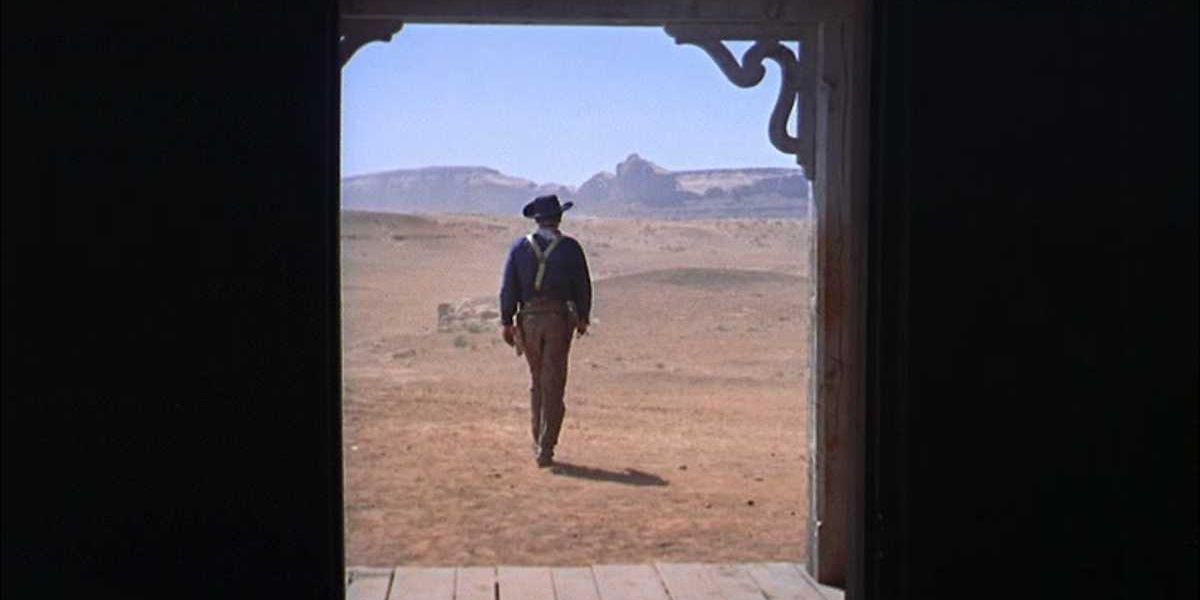
When Orson Welles was once asked about his favorite filmmakers, he replied, “I prefer the old masters, by which I mean John Ford, John Ford, and John Ford… He’s a poet and a comedian.”
John Ford is a pioneer of American cinema’s Western genre and probably the most influential filmmaker who ever lived. His filmmaking prowess was second to none—from insane stunts and gorgeous vistas to impeccable lighting and innovative camera work. He was a genius storyteller, and there’s a reason directors like Spielberg, Welles, and Kurosawa have called him the greatest to ever do it.
But where to begin with Ford is the question, because the sheer size of his filmography (more than 135 known films as a director) is daunting. Let’s start with his top nine list for now.
9 Brilliant John Ford Movies You Have to Watch
1. The Searchers (1956)
Adapted from an Alan Le May bestseller, The Searchers is Ford’s 125th feature film and is widely considered to be his best to date. As a Confederate sergeant, Ethan (John Wayne) returns to his Texas home after the Civil War, and he has brought a hatred toward Native Americans that dramatically escalates when a few Comanche men attack his homestead. Wayne spends the entire picture looking for his abducted niece and seeking revenge.
The Searchers is a revisionist Western. According to the BFI, it’s Ford’s most ambitious project delving into the psychological complexity and moral ambiguity of characters in Westerns. In addition, the movie features one of the most finely composed shots in the history of cinema, which inspired the likes of Scorsese and Spielberg.
2. The Man Who Shot Liberty Valance (1962)
John Ford and John Wayne together created much of the Old West world that we know through films. In The Man Who Shot Liberty Valance, the story focuses on Ransom Stoddard (Jimmy Stewart), who arrives in the town of Shinbone to attend the funeral of Tom Doniphon (John Wayne).
Through flashback, Stoddard tells a reporter how he first arrived in the town as a law graduate, where a gang leader, Valance (Lee Marvin), terrorized the people. Doniphon was the only one who could stand up to Valance.
Ford’s adaptation of Dorothy M. Johnson’s short story is his sad poem for the passing of the Hollywood Studio System and the traditional Western genre in the early 1960s.
3. Stagecoach (1939)
Stagecoach focuses on a stagecoach ride shared with various strangers—a prostitute with a golden heart, an evil banker, a gambler, doctors, and so much more—with an Apache threat looming over their heads as the stagecoach makes its way across the Wild West. John Wayne plays a wanted murderer named Ringo Kid and dazzles with his charisma.
Stagecoach was John Wayne’s first starring role in a film by John Ford. Since then, they have made iconic films and established themselves as one of the legendary partnerships in cinema. Even Simon Callow, in his biography, wrote that Orson Welles saw Stagecoach 40 times before he made Citizen Kane; such is the greatness of this movie.
4. The Quiet Man (1952)
The Quiet Man is an adaptation of Maurice Walsh’s story that Ford had been trying to make since acquiring rights for $10 in 1936. Typecast in Western flicks and hyper-masculine roles in war films, Wayne flexes his rom-com chops as American boxer Sean Thornton, who returns to his native Emerald Isle to find peace after accidentally killing an opponent in the ring.
His arrival causes a huge buzz among the village locals, especially Mary Kate Danaher (Maureen O’Hara), whose big brother tries to keep the boxer away from his sister. The grace and tenderness with which John Wayne handled this kind of character in Stagecoach is why Ford cast him to play in The Quiet Man.
5. The Grapes of Wrath (1940)
John Ford’s The Grapes of Wrath follows a recently paroled Tom Joad (Henry Fonda) and a barroom brawler, who returns to his home in Oklahoma. When the bank seizes his family’s drought-ridden, old farm, he moves with his family to California in the hope of a better life. The story is based on John Steinbeck’s novel, a social document of the 1930s that won the Pulitzer Prize.
The movie won Oscars for Best Director and Best Actress (Jane Darwell as Ma Joad) and was nominated for four others, including Best Actor (Henry Fonda) and Best Picture.
6. My Darling Clementine (1946)
In one of the greatest Westerns, My Darling Clementine, Wyatt Earp (Henry Fonda) and his brothers drive their cattle east to Kansas and discover a town named Tombstone. James, the youngest brother, is left behind as a watchman for the camp, while others leave to explore the town. Upon returning, they find the cattle stolen and James dead. Wyatt returns to Tombstone for revenge and becomes the new marshal, setting up a showdown between law and anarchy.
The gentlest moments in the movie involve Wyatt Earp’s feelings for Clementine (Cathy Downs). She is the best thing that happens to Marshal Earp in the story. Indeed, My Darling Clementine is one of the sweetest and most good-hearted of all Westerns, retaining all the classic Ford gunfight scenes.
7. Fort Apache (1948)
Fort Apache focuses on Owen Thursday (Henry Fonda), newly assigned to the cavalry outpost at Fort Apache and his daughter, Philadelphia (Shirley Temple). Dismissive of the assignment, Thursday is determined to wage war at Fort Apache for his personal ambition. Ignoring the advice of Capt. York (John Wayne), Thursday breaks the peace treaty with the native people and leads his men to inevitable death.
At its core, this is a film about the arrogance of man, the idiocy of underestimating your enemy and failing to give respect where it is deserved. Thursday represents the government, which disrespects Native Americans’ birthright and natural gifts, while York, who has been stationed there for some time, has come to appreciate them for what they are.
8. How Green Was My Valley (1941)
How Green Was My Valley will always be known as the movie that beat Citizen Kane at the 14th Academy Awards on February 26, 1942.
Based on the novel written by Richard Llewellyn, the film is set in the late 1800s in a Welsh coal-mining valley and covers several years in the lives of the proud Morgan family as the economic conditions shift dramatically from abundance to poverty and communal decay.
The movie is really about people struggling to come together and think of the greater good beyond their own individual wants and needs. There’s a magical scene where Huw’s (Roddy McDowall) father gives him a choice of accepting a scholarship, but the kid insists on following in the footsteps of his father and brothers to become a miner. For a moment, there’s a profound love in the father’s eyes, but then reality hits. He doesn’t want his son to live the same life of perpetual dirt and danger.
9. The Informer (1935)
‘The Informer’ (1935)Credit: RKO Radio Pictures
Both haunting and tense, John Ford’s depiction of a day in 1922 Dublin during the Irish War of Independence in The Informer landed him his first Oscar.
The plot follows Gypo (Victor McLaglen), a poor ex-army drunk who wants to leave Dublin for the United States with his girlfriend, played by Margot Grahame. When the situation calls for it, he outs his buddy, Franky (Wallace Ford), a member of the Irish Republican Army, to the British authorities. The IRA then hunts Gypo, guilt-ridden and looking for peace.
Ford and his Irish Catholic family had supported the IRA, so this film was personal for him. Joseph Breen and the Production Board feared British censorship, and as a result, the film had 129 cuts to be released.
Summing It Up
Did we miss any of your favorite John Ford classics?
Let us know in the comments.
Source link
